
LANCE LEWIN’S BLOG
Dismantling an ontological misnomer in photography: the “Latent Image”. (Entry 4/9/2026)
(Copyright: Draft – Unpublished Work © 2026 Lance A. Lewin - Do not circulate or cite without written permission from the author).
The following short discussion is from a larger more extensive work in progress titled, The Registration of Global and Determinant Features and Dismantling the “Latent Image” misnomer: an Addendum to Invisible Images and Indeterminacy: Why We Need a Multi-stage Account of Photography by Dawn M. Wilson 2021. This short essay specifically details my arguments that dismiss the “latent image” misnomer from the photographic process while proposing a new phrase that more adequately interprets the “register”– an ‘exposed but undeveloped film’ – or an integrated charge pattern distributed across a digital sensor’s photosite array.
The Ontology of Latent Images
The "magic" of water-reveal coloring books is essentially a study in optical scattering and index matching. The process begins with a permanent colorful base image that is overprinted with a porous white hydrochromic coating. In its dry state, this top layer is filled with microscopic air pockets; because the refractive index of air differs so sharply from the coating’s solid particles, light is scattered in every direction creating an opaque white mask that hides the art. When water is applied, it displaces the air and matches the refractive index of the solids more closely thus allowing light to pass through - the now-translucent layer – reveals the hidden picture (see figure 1). In another example, this same principle of controlled visibility is utilized in latent street art, where superhydrophobic (water-repellent) coatings are stenciled onto pavement; these treated areas remain dry and light-colored during rain while the surrounding concrete absorbs water and turns dark grey, revealing a design that vanishes as soon as the sun returns and the ground dries (see figure 2).
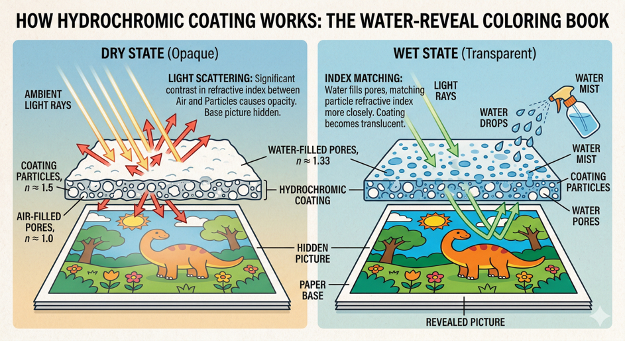
Figure 1 Hydrochromic Coating illustration
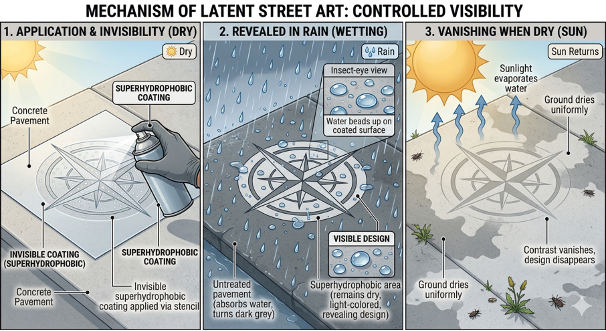
Figure 2 Superhydrophobic Coating
What is really revealed here is both examples illustrate that physical art exists - though hidden from being observed - until some type of optical-physical interaction has occurred. More importantly, there is no complex chemical reaction taking place to manifest the art; as true latent images already physically exist, though temporarily hidden from direct observation. This is strongly contrasted to the ‘preconceptions that inform single-stage orthodoxy’ so-called latent image permeating across film and digital created registers, where it is supposed to be understood a completed picture waits in hiding after the shutter on a camera opens and then closes. As I will show below, there is no scientific support for a latent image waiting to be revealed by simple methods. Instead, photographic film and digital registers need to follow through with involved (chemical and electrical) developing out processes that decode electromagnetic (photon) information towards the eventual depiction of the exposed subject or scene. This necessarily supports that an actual “physical” picture cannot possibly exist after the conclusion of the photographic event sequence.
Identifying the False-Referent Paradigm
Wilson suggests that the use of the term “latent image” in photography is simply misused [...] and ‘that some nineteenth century pioneers of photography offered characterizations that were influential and misleading’(Wilson 2021, 2023). Essentially, in the context of an image-making technology like photography, associating it with the “latent image” vernacular has necessarily created a false-referent – a misinterpretation that once the shutter closes, the camera holds a hidden picture: the "picture" as a mental reference that photographers (and later, the masses) projected onto a process that had not even finished yet - what Wilson alludes to as the [...] ‘notion of a latent image is a placeholder facilitating the idea that a captured or recorded image has persisted over time’ – that is, the visualization of a hidden or latent picture, where non actually exists. (I added the emphasis).
Within the scope of digital photography, Wilson notes ‘reinforces the preconceptions that inform single-stage orthodoxy because it creates a strong, yet false, impression that a photograph exists as soon as an exposure has occurred’ (Wilson 2021 p.169), yet further accentuating the false-referent paradigm: where rendering of digitally registered information is similarly complex to film, albeit, completed at amazing speeds, and thus the user may misinterpret this moment of instantaneity to suggest ‘the latent images described in the single-stage account just are the photographic registers’ (Windsor 2023 p.1).[1] In my opinion, surely, it would be a mistake to support such illusions.
Summarizing, the "reference" (the thought process) is disconnected from the "referent" (the actual physical process), which we have already identified in previous chapters as light-energy inscriptions that formalize photographic registers. In the case of film-based photography developing the film involves various complex processes that eventually produce a negative: though a negative enjoys some identifying marks of the exposed subject (e.g., holistic features defining shape and exposure variations, for instance), a film negative lacks other sufficient visual data that needs to be present to accurately interpret it as a completed picture of the photographed subject (e.g., distinctive features like color, texture and the details defining eyelashes, for examples). Not until further developing to produce a tangible print can the photographer then claim owning a representation of the photographed subject or scene that was composed through the viewfinder.
[1] Photographic Registers are Latent Images by Mark Windsor 2023
The Register is an “Optical Inscription”
At the conclusion of the photographic event sequence (Wilson’s ‘three senses of exposure’), ‘light-energy indices’ - the variations in both photon frequency and irradiance - are mapped across a digital sensor array or distributed onto a piece of film: optical inscriptions. Through this perspective then, photons (electromagnetic energy) is a structured carrier of data: where variations in frequency and irradiance propagating through space, we can say, are coded subject-defining attributes (e.g., holistic and distinctive features)[2]. For example, an identifying (distinctive) feature in a portrait where the sparkle in an eye begins as light energy hitting the subject and then is being re-emitted as scattered spherical waves, transforms the physical depiction of the subject into the constituents (variations in spatial frequencies and optical irradiance) that I have been collectively referring to as "light-energy indices". The irradiance or brightness that is recorded by a photosensitive substrate is directly proportional to how much energy specific features is scattered. These inscriptions need to be deciphered to manifest a depiction of the exposed subject. This clearly goes beyond the aforementioned optical-physical interactions illustrated in the examples. Instead, photography requires a complex chemical or electrical developing out (or rendering) process towards generating the first depiction of the exposed subject or scene (e.g., a film negative or what I am referring to as a RAW file inscription, often seen on a cameras review screen).
Summation
Therefore, I offer we address the register as an optical inscription – a blueprint to be deciphered during the developing out or rendering processes. I argue, then, going forward identifying photographic registers as latent images – ‘exposed but undeveloped film’ – or an integrated charge pattern distributed across a digital sensor’s photosite array would continue to represent a misleading interpretation of what actually constitutes photographic registers. Alternatively, the notion of an optical inscription relates to a relevant connection between the actions detailed in Wilson’s ‘three senses of exposure’ and what actually resides on a photographic register – a notion far removed from present-day interpretations identifying photographic registers as harboring a latent image.
On a final, uplifting thought, perhaps we can imagine meeting 20th century landscape photographer Ansel Adams (1902 to 1984) as he hiked down a mountain path carrying exposed photographic plates (that he often stated was exposed pictures) – stopping him we offer he was actually carrying a collection of “optical inscriptions” – Adams may at first give pause, but then I am confident, he would eagerly agree, as he continued striding down the mountain path with his gear.
FOOTNOTES
[1] Invisible Images and Indeterminacy: Why We Need a Multi-stage Account of Photography by Dawn M. Wilson 2021
[2] Where Holistic (or Global) features refers to general shape and outline of subjects, and Distinctive (or Determinant) features identify color variations, texture and, for example, the articulation of an eyelash. Photonically understood, and in reference to this essay, low-frequency can be said to represent global (holistic) features, and high-frequency represent determinant (distinctive) details, like an eyelash.
The Ontology of Photographic Mark Making in the 21st Century: Mind-Dependency and the Mutable Digital Image File (Entry 4/30/2026)
Abstract
This brief examines the ontological shift in photography caused by the transition from the tangible film negative to the mutable digital image file. It begins by framing my interpretation of the “visualization process", not as a preconceived prediction of the final print, but as an embodied, intentional practice of self-awareness that heightens the artist's attunement to their surrounding environment. This paper establishes that a photographic “register” [1] constitutes what I refer to as an "optical inscription", a mark formed by, what I identify as “light-energy indices”, the constituents and their variabilities representing electromagnetic energy (light). The ontology of this resulting mark diverges sharply depending on its medium. Traditional chemical development yields a tangible film negative whose foundational architectural features remain absolute. In contrast, while the initial RAW file inscription serves as a causal history of the exposed subject, the digital format allows for the effortless generation of endless, mutable clone variants. This modern capacity to infinitely rearrange and engineer foundational characteristics alters the ontology of the photographic mark, shifting the medium away from the rigid truth of an optical inscription and toward the boundless realm of traditional illustration. Ultimately, this paper advocates for the preservation of the proprietary attributes that made the nascent photography art genre so unique, while securing a foundation for future photographic pedagogy and practice.
Key Words
The Art of Photography; The Visualization Process; Visualizing-aura; Mind-dependent Agency; Mark Making; Electromagnetic energy; Light-energy Indices; Optical Inscriptions; Mutable Digital Image Files
1. On The Visualization Process and Mind-Dependent Agency
Allow me to begin with my interpretation of the visualization process: a creative path for visual artists that heightens their awareness of the surrounding environment as a source of creative inspiration. This is not to be confused with the older and often-cited notion of previsualization - championed most notably by Edward Weston (1886–1958) and Ansel Adams (1902–1984) - where the photographer is urged to “see” the final print before the shutter is released.[2] My emphasis is different. I propose the visualization process as an embodied, intentional practice of self-awareness: thus, the phenomenological experience initiated by, we can term, a visualizing-aura, becomes an immersive way of entering the world more fully, so that subject matter is not merely “found,” but disclosed through attunement. Philosophically, the visualizing-aura helps evolve visual artists’ sight into insights; an atmosphere of heightened awareness that precedes the act of creativity.
In this sense, we are moving beyond hands-on skill sets and the so-called “rules” of photography. I offer that students of photography (at all levels) benefit from engaging with a visualizing-aura that challenges them to expand the boundaries of seeing. Not because the visualization process replaces technique, but because technique without depth of attention too easily becomes habit - habit becomes imitation - and imitation becomes cliché. To learn to visualize in the context I present here, is, I argue, initiates an untethering from formalism: a loosening of the one’s creative spirit from rigid formulas that fence in perception and stifle what might otherwise be a fresh encounter with the world. Weston cautioned us plainly: “When subject matter is forced to fit into preconceived patterns, there can be no freshness of vision. Following rules of composition can only lead to a tedious repetition of pictorial clichés.” [3] I treat that warning not as rebellion for its own sake, but as a pedagogical directive: artistic freedom is not the absence of discipline; it is the right kind of discipline; disciplined in being self-aware of our creative sense.
2. The Photographic Event Sequences and the Optical Inscription
Rudimentary, when a photographic device shutter opens and then closes, electromagnetic energy (light) moves to, and then passes through the lens on its journey to a photosensitive substrate; in Dawn M. Wilson’s essay Invisible Images and Indeterminacy: Why We Need a Multi-stage Account of Photography [4] Wilson identifies what she calls the ‘three senses of exposure’ which presents a more precise (philosophical) operational-sequence for understanding the initial actions of photographing a subject - which I share in its entirely.
“It is possible to disambiguate three senses of ‘exposure’: the period of time that light is allowed to enter the camera; the event of light arriving on a photosensitive surface; and the altered state of a photosensitive surface after light has affected it. I retain ‘exposure’ in the first sense. I use ‘photographic event’ for the second sense and ‘photographic register’ for the third sense” (Wilson 2023 p.7). I will refer to the three ‘senses’ collectively as the “photographic event sequences” to help simplify writing.” [5]
At the conclusion of the photographic event sequence, what I refer to as light-energy indices, are the variations in both photon frequency and irradiance, and are mapped across a digital photosite sensor array (more popularly known as pixels) or distributed onto a piece of film, forming the optical inscription: the “mark”. Through the optical inscription perspective then, photons (electromagnetic energy) act as a structured carrier of data; variations in frequency and irradiance propagating through space. For example, an identifying distinctive feature is revealed in a portrait where the sparkle in an eye begins as light energy hitting the subject and then is being re-emitted as scattered spherical waves, or the holistic (or global) features revealed in only the shape and lines of a person standing in a shadow, we can say, are coded subject-defining attributes. These holistic and distinctive features that inscribe the register need to be deciphered to manifest a depiction of the exposed subject. Therefore, we can say, the register is an optical inscription – a blueprint to be deciphered during the developing or rendering processes.[6]
3. The Tangible Negative vs. The Mutable Digital File
Once the Optical Inscription is recorded the registered information must be processed to yield an observable image. The ontology of the resulting "mark" diverges sharply depending on the medium.
In a traditional wet darkroom, chemical development releases the registered information to create a tangible film negative. While the artist’s hand is undeniably present in virtue of using specific chemicals, temperatures, and wash times to manipulate the negative during its formation, the core, salient identifying structures of the inscription are absolute: the negative is a unique, non-editable, and tangible entity.[7] Regardless of how many times the negative is uniquely "dodged and burned" in the printing cycle, its foundational architectural features remain forever marked. For example, the negative developed from the registered portrait of an elder male sitter could be manipulated during the printing cycle to help eliminate some of the wrinkles, from perhaps this sitter’s many years in the sun. The manipulation of the negative did not alter its original structure: each time the negative is called upon in the future to make a print, the original registered exposure revealing the man’s sun-drenched wrinkled complexion will be evident. In addition, the film negative is also unique in that it cannot be represented in two places at once; a feature enjoyed by its RAW image file counterpart which we speak to next.
The digital register’s optical inscription is processed by an onboard (camera) computer into a RAW image file. Unlike the tangible film negative, this digital file does not survive as a one-time, immutable record of a registered optical inscription. The identifying salient features of the RAW digital file are not absolute. The file can produce an endless collection of clone variants. This ability to engineer the foundational characteristics - to effortlessly transpose, add, or delete salient components - from what constituted the original optically inscribed register is a revolutionary, genre-altering aspect of the digital format in photography. In addition, where a film negative can only exist in a single location, the RAW file inscription can be disseminated anywhere in the world and thus allow multiple spectators from multiple locations to view the same picture, and if arranged by the artist, for example, at the same time. However, this leads to a complimentary discussion into what defines, then, an “original” digital image file, and this question is beyond the scope of this brief, but can be explored in works by Boris Groys (b.1947) "From Image to Image File and Back: Art in the Age of Digitization" [8], and Hito Steyerl (b. 1966) "In Defense of the Poor Image" [9] to name just two of many.
4. The Philosophical Boundary of Rearrangement
The ability to infinitely rearrange the artifacts of an optical inscription goes beyond the boundaries of what initially made photography a proprietary and distinct art genre. In the traditional workflow, "mark making" was ultimately constrained by the reality in front of the lens; in the digital workflow, the optical inscription faces potential unrestricted rearrangement once the digital image file is generated. This tension is perfectly captured by early 20th-century art critic Irina Khrabroff (1885-1975). In her 1927 essay, The Art of Photography, she articulates what was long considered the medium's defining limitation:
“That a photograph made by a real artist often reveals to us the unnoticed beauty [...] a photographer is free to select and eliminate by the choice of time, point of view, focusing, etc., is obvious, also. But it is just as obvious that he cannot use the third privilege exercised by most artists over reality, that he cannot rearrange and regroup the chosen material. In other words, the purely creative function of art is denied to him. He cannot improve on reality; he has to accept it as it is. This is the great limitation of his medium.” [10]
Khrabroff emphasizes that the loss of an artist ability to engage ‘the third privilege exercised by most artists’, the ability to ‘rearrange and regroup’ what is framed through the viewfinder, inadvertently becomes the impetus that perpetuates photography as a special art genre. Khrabroff continues:
“Because all he can do is to select, his ability to select must be brought to a higher pitch than in any other form of art. His eye must be keener and quicker than eyes of the other artists.” [11]
Similarly, Sadakichi Hartmann (1867-1944) disdain ever so clear as he points a finger to most of the fifty or more Pictorialist that were represented at the exhibition of the Photo-Secession held at the Art Galleries of the Carnegie in 1904. I share Hartmann’s sentiments after he viewed three hundred photographs:
“There is hardly an exhibitor, Photo-Secessionist or not, who does not practice the trickeries of elimination, generalization, accentuation, or augmentation; and many of them, who have not the faintest idea of drawing or painting, do it in a very awkward and amateurish way”. […] “Photography must be absolutely independent and rely on its own strength in order to acquire that high position which the Secessionists claim for her”.[12]
5. Summation
When the contemporary digital file allows for the effortless manipulation, which Khrabroff noted as being able to ‘rearrange and regroup’ and ‘trickeries’ that Hartmann despised, it fundamentally alters the ontology of the photographic mark. It shifts the medium away from the rigid truth of an optical inscription and back toward the boundless - but arguably less photographically pure - realm of traditional illustration. This brief, in general, is inspired by my advocacy to bring photography back out from the shadows cast by the digital photography revolution, to again, highlight the proprietary attributes the nascent photography mostly enjoyed and practiced in the “classic tradition”[13], and I argue, should be maintained into the future as a foundation for pedagogy structure in photography education. But this brief is also to inspire a wider audience (e.g., visual artists, instructors, and patrons of the arts, among many others) in participating in this and other related discourses.
Endnotes
[1] Dawn M. Wilson, Invisible Images and Indeterminacy: Why We Need a Multi-stage Account of Photography, 2021.
2 “Visualization” as interpreted by Weston and Adams: they spoke of visualizing the final print before exposure; Adams in particular emphasized darkroom controls that could intensify what was initially exposed: Edward Weston, Photography - Not Pictorial; Camera Craft, Vol. 37, No. 7, pp. 313-20, 1930; The Ansel Adams Photography Series, The Camera-1; Little, Brown and company, NYC, Boston 1976; A Stuart A. Oring, Comparative Investigation of the Similarities and Differences in the Aesthetic Theories of Alfred Stieglitz, Edward Weston, Ansel Adams, and Minor White – 1970 p.235.
3 edited by Peter C. Bunnell, Edward Weston on Photography, published by Gibbs Smith Publishers, 1983.
4 Ibid 1
5 Dawn M. Wilson, What is a Photographic Register? 2023. Wilson describes three distinct phases (or ‘senses’, see Wilson 2023 p.7) between the time the shutter opens to allow light to pass towards, and then through the lens, and finally hitting a photosensitive surface listing the register: however, in this essay, for the purpose to simplify these distinct phases, I will refer to all three senses, collectively, as the “photographic event sequences”.
6 I argue, then, further identifying photographic registers as latent images – ‘exposed but undeveloped film’ – or an integrated charge pattern distributed across a digital sensor’s photosite array is not logical and would continue to represent a misleading interpretation of what actually constitutes photographic registers.
7 Of course, scratching or cutting the negative to manipulate the markings – much like the many 19th century Pictorialist attempting to instill ‘the hand of man’ into their photographic compositions – will, of course, alter and destroy the negative, and thus the original registered event or scene is lost forever.
8 Boris Groys, "From Image-to-Image File and Back: Art in the Age of Digitalization" (Published in Art Power, 2008).
9 Hito Steyerl, “In Defense of the Poor Image" by (Published in The Wretched of the Screen, 2012)
10 Irina Khrabroff, The Art of Photography Author, The American Magazine of Art, Vol. 18, No. 11 (November 1927), pp. 587-589
11 Ibid 10
12 Sadakichi Hartmann, A Plea for Straight Photography, American Amateur Photographer, No. 16 (March 1904), pp. 101-109.
13 Barbara E. Savedoff, Transforming Images: How Photography Complicates the Picture
Journal of Aesthetics and Art Criticism 59 (4):427-428 (2001)