
LANCE LEWIN’S BLOG
Dismantling an ontological misnomer in photography: the “Latent Image”
(Copyright: Draft – Unpublished Work © 2026 Lance A. Lewin - Do not circulate or cite without written permission from the author).
The following short essay is from a larger more extensive work in progress titled, The Registration of Global and Determinant Features and Dismantling the “Latent Image” misnomer: an Addendum to Invisible Images and Indeterminacy: Why We Need a Multi-stage Account of Photography by Dawn M. Wilson 2021.[1] This short essay specifically details my arguments that dismiss the “latent image” misnomer from the photographic process while proposing a new phrase that more adequately interprets the “register”– an ‘exposed but undeveloped film’ – or an integrated charge pattern distributed across a digital sensor’s photosite array.
The Ontology of Latent Images
Dawn M. Wilson suggests that the use of the term latent image in photography is simply misused: Wilson notes … ‘that some nineteenth century pioneers of photography offered characterizations that were influential and misleading’ (Wilson 2021, 2023), and Wilson adds, digital photography … ‘reinforces the preconceptions that inform single-stage orthodoxy because it creates a strong, yet false, impression that a photograph exists as soon as an exposure has occurred’ (Wilson 2021 p.169). So, then, what does constitute an actual latent image? Wilson’s examples from her 2021 work are a good springboard for a deeper expansion into the mechanics of latent image manifestations. Wilson offers an example where an actual latent image reveals itself … “Water-painting books for children have blank white pages which reveal their colorful latent images when water is applied to the surface” (Wilson 2021 p.166). I suggest, exploring the science how this phenomenon works will go a long way in supporting the dismantling of the “latent image” from photographic processes when juxtaposed to the articulations that define the formation of the photographic register.
The "magic" of water-reveal coloring books is essentially a study in optical scattering and index matching. The process begins with a permanent colorful base image that is overprinted with a porous white hydrochromic coating. In its dry state, this top layer is filled with microscopic air pockets; because the refractive index of air differs so sharply from the coating’s solid particles, light is scattered in every direction creating an opaque white mask that hides the art. When water is applied, it displaces the air and matches the refractive index of the solids more closely thus allowing light to pass through - the now-translucent layer – reveals the hidden picture (see figure 1). In another example, this same principle of controlled visibility is utilized in latent street art, where superhydrophobic (water-repellent) coatings are stenciled onto pavement; these treated areas remain dry and light-colored during rain while the surrounding concrete absorbs water and turns dark grey, revealing a design that vanishes as soon as the sun returns and the ground dries (see figure 2).
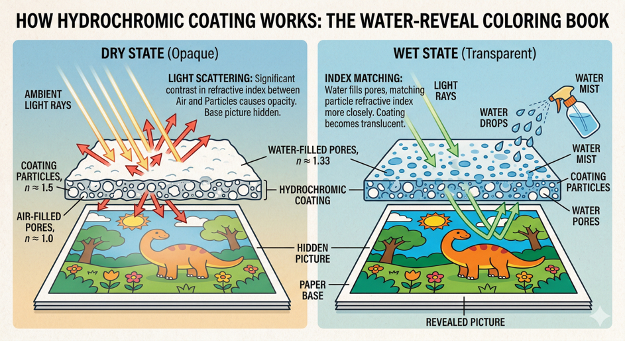
Figure 1 Hydrochromic Coating illustration
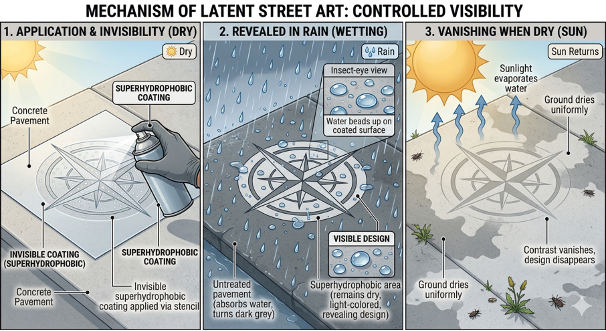
Figure 2 Superhydrophobic Coating
What is really revealed here is both examples illustrate that physical art exists - though hidden from being observed - until some type of optical-physical interaction has occurred. More importantly, there is no complex chemical reaction taking place to manifest the art; as true latent images already physically exist, though temporarily hidden from direct observation. This is strongly contrasted to the ‘preconceptions that inform single-stage orthodoxy’ so-called latent image permeating across film and digital created registers, where it is supposed to be understood a completed picture waits in hiding after the shutter on a camera opens and then closes. As I will show below, there is no scientific support for a latent image waiting to be revealed by simple methods. Instead, photographic film and digital registers need to follow through with involved (chemical and electrical) developing out processes that decode electromagnetic (photon) information towards the eventual depiction of the exposed subject or scene. This necessarily supports that an actual “physical” picture cannot possibly exist after the conclusion of the photographic event sequence. It is here I will proceed to offer a different, perhaps more logical identification of what Wilson’s photographic registers should adhere to.
The Register is an “Optical Inscription”
At the conclusion of the photographic event sequence (Wilson’s ‘three senses of exposure’), ‘light-energy indices’ - the variations in both photon frequency and irradiance - are mapped across a digital sensor array or distributed onto a piece of film: optical inscriptions. Through this perspective then, photons (electromagnetic energy) is a structured carrier of data: where variations in frequency and irradiance propagating through space, we can say, are coded subject-defining attributes (e.g., holistic and distinctive features)[2]. For example, an identifying (distinctive) feature in a portrait where the sparkle in an eye begins as light energy hitting the subject and then is being re-emitted as scattered spherical waves, transforms the physical depiction of the subject into the constituents (variations in spatial frequencies and optical irradiance) that I have been collectively referring to as "light-energy indices". The irradiance or brightness that is recorded by a photosensitive substrate is directly proportional to how much energy specific features is scattered. These inscriptions need to be deciphered to manifest a depiction of the exposed subject. This clearly goes beyond the aforementioned optical-physical interactions illustrated in the examples. Instead, photography requires a complex chemical or electrical developing out (or rendering) process towards generating the first depiction of the exposed subject or scene (e.g., a film negative or what I am referring to as a RAW file inscription, often seen on a cameras review screen).
Summation
Therefore, I offer we address the register as an optical inscription – a blueprint to be deciphered during the developing out or rendering processes. I argue, then, going forward identifying photographic registers as latent images – ‘exposed but undeveloped film’ – or an integrated charge pattern distributed across a digital sensor’s photosite array would continue to represent a misleading interpretation of what actually constitutes photographic registers. Alternatively, the notion of an optical inscription relates to a relevant connection between the actions detailed in Wilson’s ‘three senses of exposure’ and what actually resides on a photographic register – a notion far removed from present-day interpretations identifying photographic registers as harboring a latent image.
On a final, uplifting thought, perhaps we can imagine meeting 20th century landscape photographer Ansel Adams (1902 to 1984) as he hiked down a mountain path carrying exposed photographic plates (that he often stated was exposed pictures) – stopping him we offer he was actually carrying a collection of “optical inscriptions” – Adams may at first give pause, but then I am confident, he would eagerly agree, as he continued striding down the mountain path with his gear.
FOOTNOTES
[1] Invisible Images and Indeterminacy: Why We Need a Multi-stage Account of Photography by Dawn M. Wilson 2021
[2] Where Holistic (or Global) features refers to general shape and outline of subjects, and Distinctive (or Determinant) features identify color variations, texture and, for example, the articulation of an eyelash. Photonically understood, and in reference to this essay, low-frequency can be said to represent global (holistic) features, and high-frequency represent determinant (distinctive) details, like an eyelash.